
Your cart (0)
Your cart is empty
Tax included and shipping calculated at checkout
Your cart is empty
Tax included and shipping calculated at checkout

Last Updated: October 16, 2026
No, divot tools do not damage putter grips under normal use. The two pieces of gear rarely touch during play.
At Divot King, we hear this question a lot from golfers who keep a metal divot repair tool loose in the same pocket as their putter.
A divot tool is a small hand tool with two prongs, used to lift and level the turf after a ball mark.
So where does damage come from? Almost always the golf bag, not the green.
Damage happens in three specific situations, not during repair.
Sharp prongs plus a soft grip equals scratches. The fix is simple: keep them apart.
Learning how to use a divot repair tool correctly protects both the green and your gear. The tool never needs to touch your putter.
Follow these steps and you will repair pitch marks cleanly every time.
Notice step four. You use the putter, but you never touch the grip with the tool.
A common mistake is digging under the dent and pulling up. That tears roots and kills the grass. Push, lift, and press.
For official guidance on repairing ball marks and protecting greens, the R&A Rules of Golf and course care guidance is the standard reference for players.
Contact in the bag is the real culprit, and it is easy to miss.
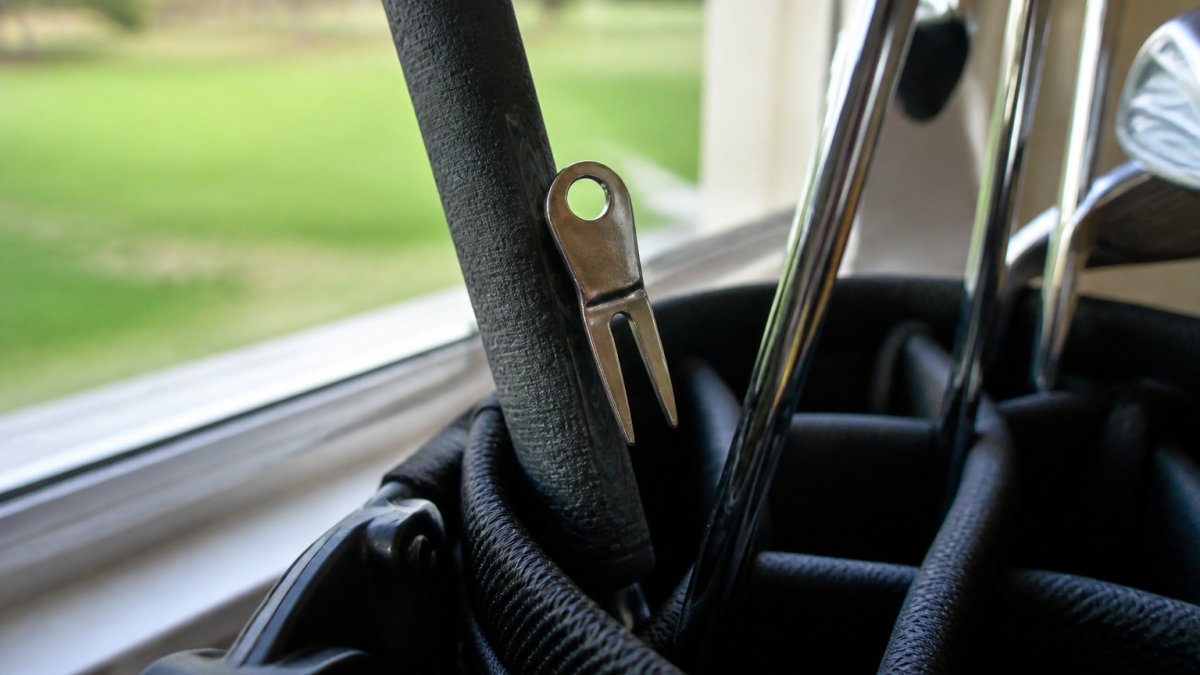
Picture your golf bag. The putter sits in its slot. A loose divot tool rolls around in the side pocket or drops to the bottom. Every time you move the bag, that tool shifts.
Most grip damage from a divot tool falls into one of three patterns:
Not all divot tools present the same hazard:
Grips are not all equally vulnerable:
The mechanism is simple: a small, hard, pointed object plus a soft, tacky surface plus movement equals a mark. The fix is to remove one of those three inputs, usually by removing the movement.
Good putter grip care starts with knowing what damage looks like, and, just as importantly, knowing whether a divot tool is even the likely cause. Most grip wear has nothing to do with a divot tool. Here is how to tell the difference.
| What you see | Likely cause | Divot tool involved? |
|---|---|---|
| One or two small punctures or pinholes | Prongs pressed into the grip | Often yes |
| A short, straight scratch or gouge | Tool edge scraped across the surface | Often yes |
| A flattened or dented patch | Static pressure from a tool or club | Sometimes |
| Smooth, shiny patches along the whole grip | Hand oils, sweat, and friction from play | No |
| Cracking along the seam or butt end | Age, UV, and cold weather | No |
| Fraying cord strands | Normal abrasion from the hands | No |
| A grip that twists or feels loose | Adhesive failure or a stretched core | No |
The pattern matters. Divot-tool damage is usually localized, one spot, one shape, one event. Normal wear is distributed, it shows up where your hands sit and builds gradually over months.
Run your thumb around the grip once a month, but do it in good light and in this order:
Do not tape over a deep cut and keep playing. Tape traps moisture and the grip will fail.
A useful rule of thumb: if the damage changes how the grip feels in your hands, replace it. If it only changes how it looks, you can usually keep playing. A new grip costs far less than a ruined round, and a putter grip is the one piece of equipment you touch on every single hole.
For broader equipment standards, the USGA equipment and course care resources covers how gear and turf care fit together.
The right putter accessories solve the storage problem at the source. Instead of carrying a loose tool, use gear that holds everything in one place.
Here is how the common options compare.
| Accessory | Keeps Tool Off Grip | Best For | Storage Style |
|---|---|---|---|
| Loose divot tool in pocket | No | Nothing | Unprotected |
| Clip-on ball marker | Partial | Quick marking | Clips to putter |
| Putter-mounted multi-tool | Yes | Frequent players | Attached to putter |
| Universal putter adapter | Yes | All-in-one setup | Sleeve on grip |
The pattern is clear. Tools that attach to the putter stay put. Tools that float loose cause damage.
A ball marker holder and a marker that clips to the putter also cut down on pocket clutter.
A universal putter adapter changes storage by attaching the tool to the putter itself.
The Divot King adapter is a soft sleeve that fits most putters.
That cover is the key detail. It means the sharp end never touches your grip, because it is capped.
Three things this setup fixes:
If you play often, this is the simplest way to protect both your grip and your greens.
A small nick is not a crisis. A puncture needs a closer look.
Start with these steps:
Do not tape over a deep cut and keep playing. Tape traps moisture and the grip will fail.
If the damage is minor, a light sanding restores the feel.
The Golf Australia course care and equipment notes offers further guidance on keeping gear and greens in good shape.
Putter grip damage from a divot tool is rare, but it is completely avoidable with the right habits.
Yes, if the prongs or sharp edge of a metal divot tool press against the grip with enough force. Rubber and synthetic grips can be scratched, torn, or punctured when a hard metal tip digs in during storage or handling. The risk goes up if the tool shares a pocket or slot with the putter and shifts around. Keeping the tool in a separate compartment or using a protective cap reduces that contact and keeps grip integrity intact.
Store it in a side pocket away from clubheads and grips, or use a tool with a protective cover. If you clip it to the outside of the bag, check that the prongs face outward, not toward a shaft or grip. Never drop a loose divot tool into the same slot as your putter. A dedicated pouch or a covered multi-tool keeps the sharp edge contained and stops the tool from sliding against your putter grip during transport.
Not always. Sleeve adapters and clip-on accessories vary in diameter, so they fit some putter shafts and grips better than others. A universal putter adapter is designed to fit most standard putters, but oversized or unusually shaped grips may need a different size. Check the adapter's stated fit range before buying, and test the attachment at home. If it wobbles or sits loose, it may shift in the bag and rub against the grip.
Look for visible nicks, tears, or flat spots, and check for a slick or shiny surface where your hands sit. If the grip feels hard, twists on the shaft, or has a puncture from a tool tip, it is time to replace it. A worn grip affects how the putter sits in your hands and can change your feel on the green. Replacing it is inexpensive compared with the cost of missed putts.