
Your cart (0)
Your cart is empty
Tax included and shipping calculated at checkout
Your cart is empty
Tax included and shipping calculated at checkout

Last Updated: October 11, 2026
The best putter accessories solve real problems: they help you mark your ball consistently, repair divots properly, and keep your putter protected. When you eliminate clutter and focus on tools that actually work, your confidence improves and your rounds flow better.
A quality putter accessory should attach securely, function reliably under pressure, and make course maintenance effortless. Many golfers overlook this category, assuming a coin and divot tool are enough, they're not.
Alignment is where many putts go wrong before the stroke begins. A putting alignment aid gives you a visual reference line or gate to aim through, training your eyes to square up properly while remaining simple enough not to slow play.
Alignment is a skill you can improve with the right feedback. When you use an alignment aid during practice, your brain learns the proper feel of a square setup, which transfers to the course without the tool.
A putting training aid gives you immediate feedback on what your stroke is actually doing. Gate drills force you to swing on line; if your putter drifts, you hit the gate, building better habits faster than practice alone.
The most effective training aids address specific weaknesses. If you're leaving putts short, a pace trainer helps you feel the right tempo. Choose based on your biggest struggle, not what looks impressive.
A golf ball mark repair tool fixes the damage your ball leaves on the green. A properly repaired mark heals in days; a poorly repaired one takes weeks to recover.
The best repair tools have a forked or spiked design that aerates the soil as you lift, promoting healing. A coin compresses soil instead of loosening it.
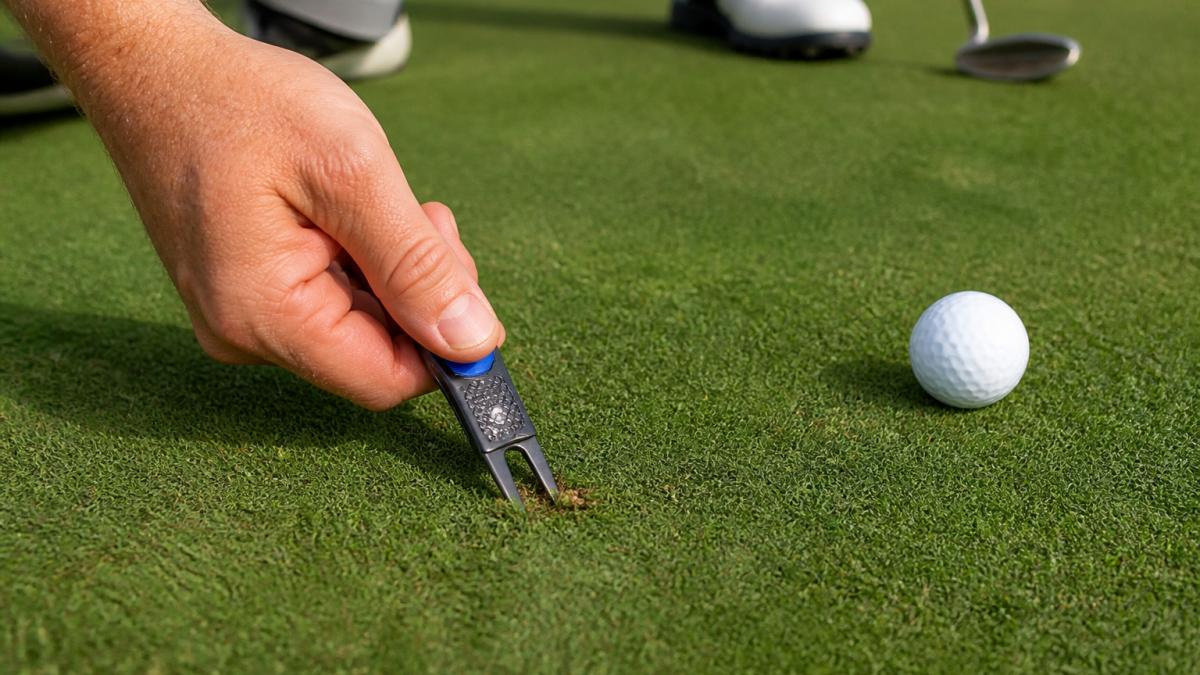
Divot King combines a ball marker with a repair tool in one compact attachment, so you always have both when you need them. The universal sleeve adapter fits most putter grips, and the protective cap keeps it safe in your bag. This eliminates the excuse of not having the right tool available.

The right practice mat depends on your space, your specific weakness, and how honestly you want it to challenge you.
Types of practice mats and their best uses, Flat mats (3-4 feet, $50-$120) work for stroke mechanics and short putts but don't teach distance control. Mid-length mats (8-12 feet, $120-$250) add lag putting and speed control. Full-length mats (15+ feet, $200-$500+) simulate course conditions. Choose based on your biggest weakness: short putts need a short mat; distance control needs at least 8 feet.
Mat quality and stimp speed, A cheap mat ($30-$50) will have inconsistent roll, dead spots, and unrealistic speed that doesn't match your home course. This teaches bad habits because your stroke feels different on the mat than on the course. A quality mat has consistent nap direction, uniform pile height, and a stimp speed (the distance a ball rolls when struck from a standard height) between 10 and 12 feet, close to typical course greens.
Compatibility with different putter types, Some mats have raised rails or gates designed for specific putter head shapes (blade putters, mallets, or heel-toe weighted designs). Before buying, confirm your putter head fits through any gates or guides without catching. If you use a large mallet putter, a mat with narrow guides will frustrate you and won't get used. Test the fit by bringing your putter to a golf shop or ordering from a retailer with a return policy.
Realistic practice structure and measurement, A mat only improves your game if you use it consistently and measure your progress. Set up a repeatable practice routine: pick a distance (6 feet, 12 feet, etc.), make 10 putts, and record how many you make. Do this 3 times per week for 4 weeks. If your percentage improves, the mat is working.
Space and portability trade-offs, A mat that takes up your entire garage won't get used regularly because setup and breakdown become a chore. A smaller mat (4-6 feet) that you can roll up and store in a closet gets far more use. Consistency of practice beats the size of the mat.
Durability and long-term value, Quality mats last 3-5 years with regular use before the nap wears down and speed changes. Budget mats degrade in 6-12 months. Calculate the cost per month of use: a $200 mat used 4 times per week for 3 years costs about $3 per session, while a $50 mat used sporadically for 6 months costs $10+ per session. The better mat is often the better value if you commit to using it.
The most effective way to choose putter accessories is to diagnose your specific putting weakness first, then match it to the right tool. This problem-based approach prevents impulse buying and ensures every accessory you add actually addresses something measurable in your game.
Poor alignment and setup consistency, If you consistently aim left or right of your target, or if your putter face is open or closed at address, alignment aids and setup trainers are your priority. These tools give you visual feedback during practice so your body learns the correct feel. Without alignment work, other accessories won't help because your stroke starts from the wrong position.
Inconsistent pace and distance control, If you leave putts short, run them past the hole unpredictably, or struggle with lag putting from 30+ feet, a pace trainer or distance-control mat is more valuable than alignment work. These tools train your tempo and help you develop a consistent stroke length for different distances.
Poor green reading and break prediction, If you read greens incorrectly or miss the line even when you aim correctly, alignment aids won't solve this. Instead, focus on green-reading practice tools, slope trainers, or simply practicing on actual greens with a coach or experienced player who can give you feedback. Accessories alone cannot teach you to read breaks; only repetition and feedback do.
Slow pace of play or disorganization, If you lose ball markers, forget divot tools, or fumble with loose items in your bag, a putter-mounted attachment that combines a marker and repair tool solves the problem immediately. Test compatibility before buying: confirm the attachment fits your grip diameter (standard grips are 0.6 to 0.9 inches), doesn't interfere with your stroke, and stays secure during a full round. Carry it for 9 holes and verify it doesn't shift or rattle.
Testing methodology for any accessory, Before committing to a purchase, use the tool for at least 50 practice putts and one full round (or 9 holes minimum). Measure one specific metric: alignment accuracy, distance control consistency, pace of play, or comfort. If that metric improves and the tool feels natural in your hand, it's worth keeping. If it feels awkward, slows you down, or doesn't produce measurable improvement, return it.
Compatibility and fit checklist, Before purchasing, verify: (1) grip diameter compatibility (check your putter grip size), (2) attachment method (does it clamp, slide, or screw on?), (3) weight and bulk (does it add noticeable heft or interfere with your swing?), (4) storage fit (does it fit in your golf bag pocket or cart without snagging?), and (5) ease of access during play (can you reach it quickly without removing your putter from the bag?).
The biggest mistake is buying accessories without a clear purpose. Many golfers chase the latest gadget without understanding what problem it solves. This leads to drawers full of unused tools and wasted money. Before you buy, ask yourself: what specific aspect of my game will this improve? If you can't answer that clearly, don't buy it.
Another common error is ignoring comfort and feel. An accessory that doesn't feel right in your hand won't get used, no matter how effective it is in theory. Always test how something feels before committing. Borrow from a friend or try it at a golf shop if possible. The wrong feel is a deal-breaker.
Many golfers also buy too many accessories at once, hoping variety will solve everything. This approach creates confusion and prevents you from understanding what actually works for your game. Build your accessory collection slowly, one tool at a time. This forces you to truly evaluate whether each piece improves your results.
The difference between a golfer who shoots consistently lower scores and one who doesn't often comes down to attention to detail. Your putter accessories reflect that commitment. Divot King simplifies this decision by combining ball marking, divot repair, and putter protection into one tool designed by golfers who understand what you need on the course. The magnetic ball marker stays secure, the universal sleeve adapter fits your putter grip, and the protective cap keeps everything safe in your bag. Get yours and keep your greens immaculate while simplifying your game.
The most effective putter accessories address three core areas: alignment (helping you aim straight), consistency (training your stroke mechanics), and course care (marking balls and repairing divots efficiently). Alignment aids like mirrors and gates show you setup flaws instantly. Training aids build muscle memory for repeatable strokes. Ball markers and divot repair tools streamline your routine and demonstrate respect for the course, which indirectly improves focus. The Divot King combines ball marking and divot repair in one tool, eliminating the need to carry multiple items and keeping your pockets less cluttered during play.
Alignment aids work because they provide immediate visual feedback about your setup. A putting mirror shows whether your eyes are over the ball and your shoulders are square to the target line. A putting gate forces your putter head to follow a straight path, training proper stroke mechanics. The feedback is concrete and measurable, not theoretical. Most golfers who use alignment aids consistently report tighter groupings and lower putts per round. They're most valuable during practice; on the course, they build confidence in your setup routine.
Check the grip diameter and material of your putter. Most modern putter grips are standard diameter (around 0.6 inches), but oversized grips are thicker. Universal sleeve adapters like those on the Divot King are designed to fit standard and mid-sized grips securely. If your putter has an unusual grip shape or extra-oversized grip, test the fit before committing. Ball markers that clip to the grip should sit snugly without rotating. Headcovers are typically one-size-fits-most, but blade and mallet putters may need different styles.
A ball marker temporarily marks your ball's position on the green so you can lift and clean it. A divot repair tool removes the spike marks left by ball impact and restores the grass. Traditionally, golfers carry both separately, adding bulk to their pockets. A combined tool like the Divot King eliminates this redundancy: the magnetic ball marker serves its purpose, and the spikes repair the mark once you've putted. This saves space and ensures you always have both tools when you need them, which is especially valuable in tournament play where efficiency and course etiquette matter.