
Your cart (0)
Your cart is empty
Tax included and shipping calculated at checkout
Your cart is empty
Tax included and shipping calculated at checkout

Last Updated: October 9, 2026
No, a magnetic ball marker does not damage a putter grip when the holder is installed correctly. This is the question we hear most at Divot King, and it deserves a straight answer: the magnet itself never touches your grip. Only the holder does, and that contact is gentle by design. The fear usually comes from a bad experience with a cheap clip-on marker that pinched the rubber, or from forum threads where someone blamed a magnet for a tear that actually came from forcing a grip over a shaft.
A magnetic ball marker holder is a small base that fits into or over the butt end of your putter grip, with a magnet that holds a metal ball mark in place until you slide it off. The base does the work. The magnet just keeps the marker from falling out of your pocket or rolling off the green.
Clip-on markers grip the outside of the grip with spring tension or a plastic jaw. That constant clamping pressure is where grip damage usually starts. Magnetic systems avoid it because the holder sits at the butt end, above where your hands sit during a putting stroke, and holds the marker with magnetic pull instead of mechanical squeeze.
The trade-off is simple:
Magnet strength matters less than people think. A marker only needs enough pull to stay seated during a round, not enough to fight you when you pull it off. What matters more is the material of the holder and how it meets the grip.
Modern putter grips are built from rubber compounds, foam cores, and synthetic wraps. Each reacts differently to pressure and heat.
Attaching a ball marker to a putter grip takes about two minutes and requires no tools beyond what comes in the pack. The goal is a snug fit with zero twisting force on the rubber.
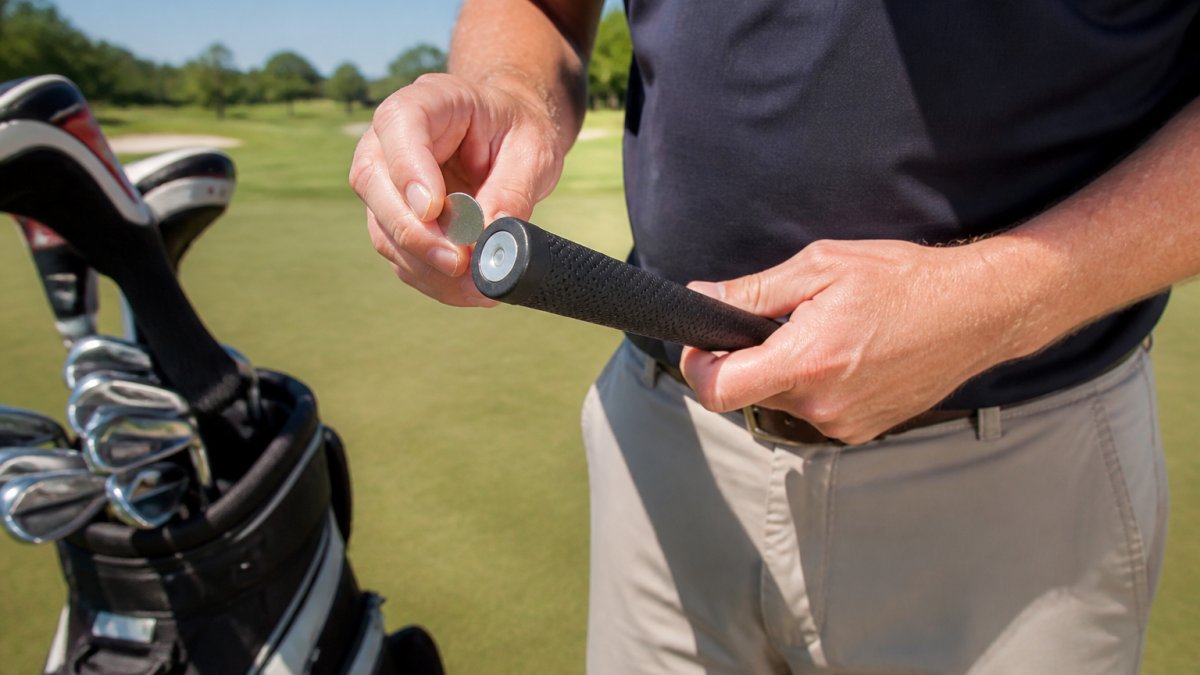
Skip the screwdriver. Skip the tape. If a holder needs force to go on, it is the wrong size, and forcing it is how grips split.
Magnets do not run out of power. What fails is the interface between the magnet, the marker, and the holder. Understanding the three real failure modes lets you fix the problem in seconds instead of replacing gear.
A magnet's pull drops exponentially with distance. Even a thin layer of bag grit, sunscreen residue, or metal shavings from other clubs creates an air gap that can cut holding force by half. This is why a marker that clicked firmly in March falls out by July. The fix is mechanical, not magnetic: wipe the magnet face and the back of the marker with a dry cloth every few rounds.
Most putter-grip holders use neodymium magnets (NdFeB) because they offer the strongest pull per gram. Neodymium is brittle and corrodes quickly if uncoated, so quality holders use a nickel-copper-nickel plating. Once that plating chips, usually from dropping the putter or scraping the holder against a bag divider, the magnet begins to oxidize. Oxidation does not kill the magnet overnight, but it does weaken the field and stain the grip.
A holder that shifts even a millimeter changes the contact geometry between magnet and marker. This is not a magnet problem; it is a fit problem. Sleeve adapters that rely on friction can creep over time, especially in hot cars where rubber expands. The symptom is a marker that rattles instead of clicking. The fix is to reseat the adapter fully and check that the butt end of the grip is clean and dry before installation.
If your marker starts dropping out, clean both surfaces, check the holder seat, and inspect the plating. In most cases the magnet is fine and the interface is the problem.
Grip wear is real, but it comes from your hands, sunlight, and heat, not from a magnet. Rubber compounds harden and glaze over time. Foam cores compress where your thumbs sit. That happens whether or not you carry a marker on your putter.
Here is what actually accelerates grip breakdown:
A properly fitted magnetic holder avoids the third item on that list, which is the only one an accessory can cause.
Swing weight is not total weight. It is a measure of how heavy the club feels when you swing it, expressed on a letter-number scale (C9, D2, D4, etc.). Adding mass to the butt end of a putter makes the head feel lighter, which lowers the swing weight number.
A magnetic ball marker holder sits at the butt end, so it lowers swing weight. The question is by how much.
Swing weight is measured in 14-inch increments from the butt end. A common rule of thumb among clubmakers is that adding about 4 to 5 grams at the butt end reduces swing weight by roughly one point.
For context, one swing weight point is roughly the difference between a standard putter and one with a slightly heavier grip. Many players cannot feel it. Others, especially those who play counterbalanced putters, notice immediately.
| Accessory Setup | Typical Added Weight | Approx. Swing Weight Change | Who Notices |
|---|---|---|---|
| Marker only, no holder | 1-2 g | Less than 1 point | Almost nobody |
| Magnetic holder plus marker | 3-6 g | About 1 point | Sensitive players |
| Holder, marker, and cap | 5-8 g | 1-2 points | Counterbalance users |
| Multiple butt-end accessories | 10 g+ | 2+ points | Most players |
Grip warranties cover manufacturing defects, not damage from installation or add-on accessories. That distinction matters. If a grip splits because a holder was forced on, that is on the installer, not the grip maker.
Most grip brands will not honor a claim if the grip shows signs of being stretched, cut, or modified. A sleeve-style adapter that slides over the butt end without cutting or drilling keeps you on the safe side of that line.
Losing markers is the complaint we hear most, and it is almost always a retention problem, not a magnet problem. Fix retention and you fix both issues at once.
This is where an all-in-one tool earns its place.
Putter grip damage from a magnetic ball marker is avoidable, and the fix is a properly fitted holder rather than a different accessory category.
A magnetic ball marker itself won't damage a rubber or synthetic putter grip. The risk comes from how the holder attaches. Adhesive-backed holders can leave residue or peel grip material when removed. Clip-on or sleeve-style holders avoid this because they don't use glue. If you use a magnetic ball marker holder that relies on a mechanical fastener or sleeve, your grip stays intact. Always check that the holder fits your specific grip diameter to prevent stretching or tearing.
Yes, magnetic ball markers can lose strength, but it usually takes years of regular use. Heat, moisture, and repeated impact can weaken the magnet. Cheaper magnets with low-grade material degrade faster. A quality magnetic ball marker holder uses a strong neodymium magnet. If your marker starts sliding off easily or feels loose, the magnet may have weakened.
The safest method is to use a holder with a soft universal sleeve adapter that slides over the butt end of your grip. No adhesive, no screws. Clean the grip first, slide the sleeve on, and secure it according to the manufacturer's instructions. Avoid holders that require drilling or permanent adhesive. If you need to remove the holder, gently twist and pull it off. This keeps your grip's rubber compound and surface intact.
A small magnetic ball marker won't affect your putter's performance or the club's metal. Putter heads are made from stainless steel, carbon steel, or aluminum, none of which react to a weak magnet. The magnet only holds the marker to the holder. It won't alter swing weight or loft. If you're using a magnetic holder on your grip, the magnet sits at the butt end, far from the clubface, so there's no impact on your putting stroke.