
Your cart (0)
Your cart is empty
Tax included and shipping calculated at checkout
Your cart is empty
Tax included and shipping calculated at checkout

Last Updated: October 7, 2026
The best golf divot repair tools for tournaments are the ones you never have to think about: compact, quick to deploy, and gentle enough on the putting surface that a repaired ball mark heals in days rather than weeks. At Divot King, we build around one idea: the tool should already be on your putter, not buried in your bag. A ball mark is the indentation a golf ball leaves when it lands on the green, and repairing it properly is both a courtesy and, in most competitions, an expectation.

Here's the tension most buying guides skip. In casual play, a slow repair costs you nothing. In a tournament, every second over the ball matters, and fumbling through pockets for a tool you can't find is exactly the kind of friction that breaks focus.
So what actually separates a tournament-ready tool from a gadget?
Below, we break down the designs, the correct repair technique, and how to judge durability before you buy.
Correct ball mark repair follows one principle: work from the outside in, pushing grass toward the center, never levering the tool upward. Insert the prongs at the edge of the mark, push the surrounding turf toward the middle, then press the repaired area flat with your putter.
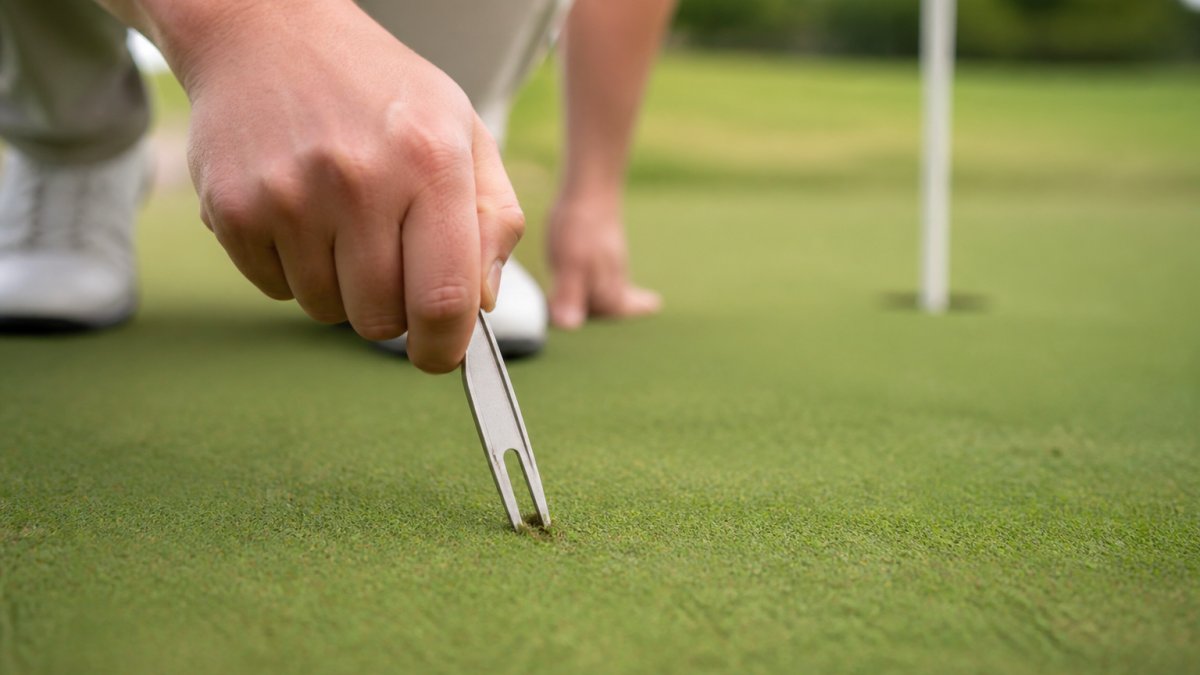
Why does this matter in competition? A ball mark left unrepaired kills the grass beneath it, and the scar can take weeks to recover. The USGA guidance on repairing ball marks is clear that lifting the turf rather than prying it tears fewer roots and speeds healing. Tournament committees notice. More practically, a green pocked with unrepaired marks rolls inconsistently, and you putt on that surface too.
A common mistake is the "twist and pull" method: jamming the tool in and levering up. It looks like repair, but it rips roots and leaves a brown spot. Push, don't pry.
A switchblade divot repair tool wins on convenience; a fixed fork wins on simplicity and durability. But for tournament play, the deciding factors go beyond casual convenience. You need a tool that deploys silently, opens one-handed without looking, and stays secure in your pocket during a round. This section compares the two designs on those tournament-ready criteria.
Deployment speed and one-handed operation
In competition, every second counts. A switchblade with a well-tuned spring opens with a thumb flick, often without looking down. Fixed forks are instant, no mechanism, but require two hands to pull from a pocket and orient the prongs.
Noise and distraction
A switchblade's snap can be audible on a quiet green, especially if the spring is stiff. Some tournament players prefer a fixed fork for silence. If you use a switchblade, test it at home: a faint click is fine, but a loud snap might draw glances. Fixed forks are silent by nature.
Pocket security and comfort
Switchblades fold into a compact body that sits flat, but the hinge can loosen over time, causing the tool to open slightly in your pocket, a snag risk. Fixed forks have exposed prongs that can poke through thin fabric or scratch your leg. For tournament play, look for a switchblade with a locking mechanism or a fixed fork with a sheath or rounded tips.
Durability under repeated use
The hinge is the weak point on any switchblade. After hundreds of opens, the spring may weaken or the pivot may develop play. Fixed forks have no moving parts, so they resist bending and breaking better, provided the metal is thick enough. A common pattern among tournament golfers is to carry a fixed fork as a backup and a switchblade for quick access.
Tournament-ready selection criteria
When choosing between the two, ask:
For most tournament players, a switchblade with a secure lock and a quiet deployment is the best balance. But if you prioritize absolute reliability and silence, a fixed fork with a cover remains a strong choice.
A golf divot tool with magnetic ball marker solves a specific annoyance: keeping your marker and your repair tool together so neither goes missing. The magnet holds the marker against the tool body, so you mark your ball, repair your mark, and replace the marker without a separate trip to your pocket.
The failure mode to watch for is magnet strength. A weak magnet means the marker drops out in your bag or on the fringe, and you're back to borrowing a coin. Look for a marker that seats with a positive click or a firm pull, not a loose rattle.
R&A rules on ball markers and equipment confirm that a marker used to lift and identify your ball is standard equipment, so there's no rules concern with carrying one attached to your tool.
This is where an all-in-one approach earns its keep. Divot King pairs a magnetic ball mark with a universal sleeve adapter that fits most putters, so the tool rides on your grip instead of in your pocket. The protective click-on cover keeps it secure in the bag between rounds.
A putter-mounted divot repair tool attaches to your putter grip, which means it's in your hand every time you walk onto a green. No pocket dig, no bag search, no borrowing. You pull the putter, and the tool is already there.
Divot King is built exactly for this. Its soft universal sleeve adapter fits most putter grips, and the tool uses spikes to aerate the soil, promote growth, and fluff the green back into shape after a ball mark. Because it lives on the putter, it also trims the number of items competing for pocket space.
Does it slow you down in competition? The opposite, if it's designed well. The whole point is removing a step from your routine. You mark, you repair, you putt, and nothing interrupts the sequence.
If you're coming from a traditional pocket tool, expect a short adjustment period while you build the habit of reaching for your grip instead of your pocket.
Durability, ergonomics and price separate tools that survive a season from tools that disappoint by July. But tournament-ready means more: the prongs must hold their shape after repeated use in firm turf, the grip must allow one-handed deployment without slipping, and the tool must stay secure in your pocket during play.
Durability: stress-testing prongs and hinges
Most practitioners find that thin stamped alloys bend after a few dozen repairs in firm conditions, while forged stainless steel or titanium resists deformation. To test a tool before you buy, hold the prongs between your thumb and index finger and apply moderate pressure, if they flex easily, they will bend in the ground.
Ergonomics: grip, hand strength, and accessibility
Tournament play often means repairing marks quickly, sometimes while wearing a glove. A tool with a textured grip or a contoured handle reduces slip. For golfers with limited hand strength or arthritis, a larger handle or a lever-style tool (like some fixed forks with a wide top) requires less pinch force.
Pocket security and one-handed deployment
A tournament-ready tool must not snag, open, or poke you when you walk. Switchblades should have a secure lock; fixed forks need a sheath or rounded tips. Test one-handed deployment: can you retrieve and open the tool without looking? If you have to fumble, it will slow you down on the green.
Price vs. value
Price is a poor proxy for quality. A simple fixed fork made of thick stainless steel may cost less than a multi-tool with a bottle opener and outperform it in durability. What you're paying for is fit, finish, and whether the design matches your routine.
Evidence-based comparison of repair effectiveness
When comparing designs, use consistent criteria: repair quality (does the turf lie flat?), turf disturbance (does it tear roots?), and ease of use (can you repair in under 10 seconds?). A switchblade with thin prongs may lift turf gently but bend easily; a fixed fork with thick prongs may be durable but tear if not inserted at the right angle.
Tournament-ready checklist
Use this checklist when evaluating any tool, and prioritize reliability over extra features.
The best golf divot repair tools for tournaments are the ones that disappear into your routine: quick to deploy, comfortable to carry, and sturdy enough to last a full season of competitive rounds. Prioritize deployment speed, prong durability, and a marker that stays attached.
Tournament-ready divot repair tools prioritize speed, reliability and one-handed operation. Look for a tool you can deploy without digging through your bag, a secure ball marker that won't fall out mid-round, and prongs strong enough to lift turf without bending. A putter-mounted option like Divot King keeps the tool attached to your grip, so you can repair a ball mark in seconds and stay focused on your next putt.
Insert the prongs around the edges of the ball mark, not the center, and work the turf inward toward the middle. Lift gently rather than pulling up, then press the repaired area flat with your putter. Working from the outside in fluffs the turf back into shape without tearing roots. This technique keeps the putting surface smooth and helps the greenkeeper's job stay manageable.
A golf divot tool with magnetic ball marker keeps your marker and repair tool in one place, cutting down on pocket clutter and lost markers. The magnet holds the marker securely during play, then releases it with a quick flick when you need to mark your ball on the green. For tournament players who value speed and organization, this combination removes one more small distraction from the round.
A divot repair tool damages the green only when used incorrectly. Prying upward from the center of the ball mark tears roots and leaves a scar. Insert the prongs at the edges, push the turf toward the center, and press flat. Used this way, the tool helps the turf recover faster. Some designs, like putter-mounted tools with spikes, also aerate the soil slightly as they work.
Tournament golf rewards players who keep their gear simple and their focus intact. If you're tired of digging through pockets for a tool that should already be in your hand, Divot King is our answer: a putter-mounted tool with a built-in magnetic ball mark, a soft universal sleeve adapter that fits most putters, and a protective click-on cover for bag storage. Get started with Divot King and keep every green you play in pristine shape.