Magnetic Ball Marker Losing Strength? Fix It Fast

Article author: Editorial Team Article published at: Oct 4, 2026
Magnetic Ball Marker Losing Strength? Fix It Fast

Table of Contents

Last Updated: October 4, 2026

Why Your Magnetic Ball Marker Loses Strength (And How to Test It)

A magnetic ball marker losing strength is almost never a magnet problem. At Divot King, we hear this complaint constantly from golfers who assume the magnet has simply "worn out." In practice, the magnet is usually the last component to fail.

Here is what actually happens. A neodymium magnet is a brittle, plated disc. It does not fade like a battery. What fades is the air gap between the magnet and whatever steel surface it grabs.

So before you replace anything, test it.

Quick pull-force test you can do at home

  • Clean and dry both the magnet face and the mating surface
  • Stick the marker to a steel putter head or a fridge door
  • Add small weights (coins, tees, ball markers) until it drops
  • Repeat with the same stack on a brand-new marker for comparison
  • Note the difference: if a clean marker holds the same stack, your magnet is fine

If the clean marker holds noticeably more, you have a debris problem, not a magnet problem. If both fail the same way, the magnet has genuinely degraded or the plating has failed.

Pro Tip Test on a flat steel surface, not the curved hosel of your putter. Curvature reduces contact area and makes a healthy magnet look weak.

How to Clean a Golf Ball Marker Magnet Without Damaging It

Cleaning a golf ball marker magnet is not about making it look shiny. It is about restoring the air gap between the magnet face and the steel surface it grabs.
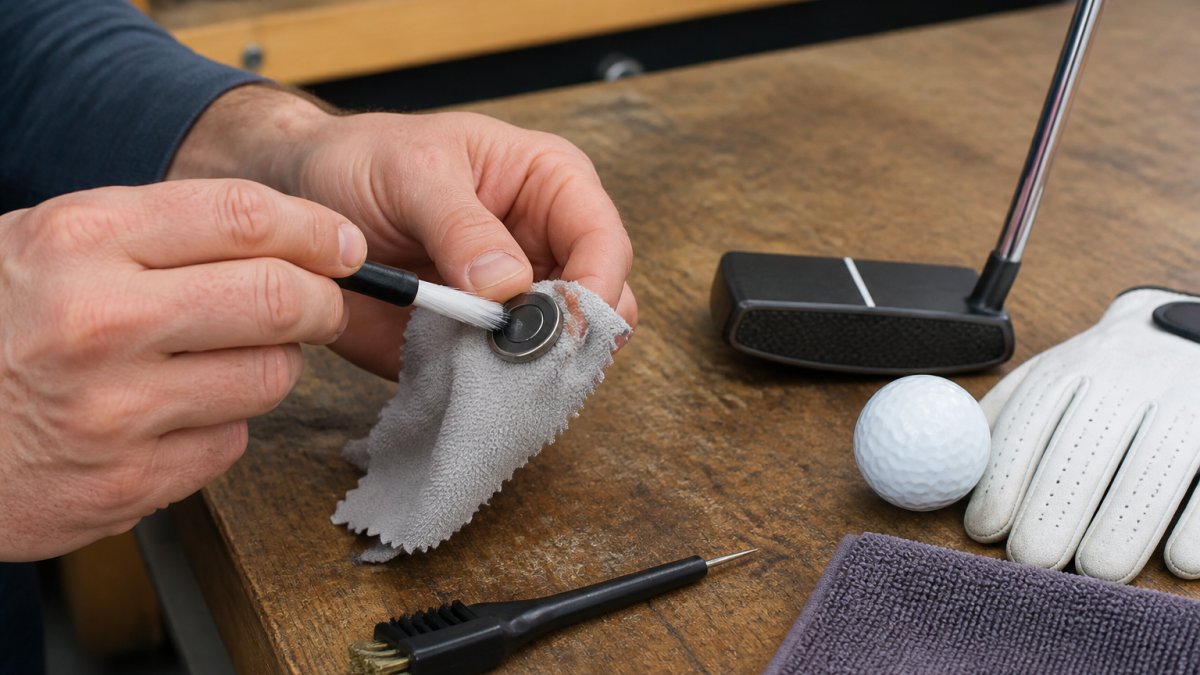
Close-up of a golfer's hands using a soft cloth and small brush to clean a magnetic ball marker on a workbench, with a putter and golf glove nearby

Why water is the wrong first move

Water does not dissolve the grit that causes most pull-force loss. It does, however, drive surface oxidation on plated neodymium. Most marker magnets are nickel-copper-nickel plated, and once moisture reaches a chip or seam in that plating, rust forms underneath and lifts the finish from the inside. That is why the routine below is dry-first, and why a wet wipe is a last resort rather than a default.

Step-by-step cleaning routine

  1. Dry-wipe the face. Use a dry microfibre cloth. One firm pass, no scrubbing. Scrubbing embeds grit into the plating rather than lifting it.
  2. Brush the crevice. A soft nylon toothbrush lifts packed debris from the seam between magnet and housing. Work in one direction, not circles.
  3. Pick the edges. A wooden toothpick removes sand wedged against the magnet rim without scratching plated surfaces. Never use a metal pick or flathead screwdriver.
  4. Check the mating surface too. The putter head, divot tool, or hat clip backing is half the equation. A clean magnet against a dirty steel plate still loses pull force.
  5. Dry fully, then wait. Let the marker air out for a few minutes before it goes back in the bag. Trapped moisture in a closed cover is worse than no cover at all.
  6. Re-test pull force. Repeat the coin-stack test from the first section. If the stack size is back to normal, the magnet was never the problem.

What to avoid, and why

  • Solvents and alcohol wipes. They strip the clear coat on chrome finishes, and that clear coat is the corrosion barrier.
  • Dishwashers and ultrasonic cleaners. Heat and vibration can loosen plating at the seam.
  • Metal brushes and steel wool. They scratch the plating and create the exact micro-chips that let rust start.
  • Oils and lubricants. A drop of oil feels like it helps, but it attracts grit and turns into a grinding paste.
Pro Tip If the magnet face looks dull or cloudy after cleaning, the plating has already started to fail. Cleaning will not bring it back, that is a replacement signal, not a maintenance one.

A clean, dry marker with intact plating will hold near its original pull force for years. The failure mode is almost always contamination or plating damage, not the magnet itself.

Golf Ball Marker Falling Off Hat? Fix the Clip, Not the Magnet

A golf ball marker falling off your hat is usually a clip tension issue, not a magnetic one. Hat clips hold the marker with spring pressure against a visor attachment point.

Test it like this:

  • Clip the marker to a hat brim and shake it firmly
  • If it slides sideways, the clip is loose, not the magnet
  • Squeeze the clip gently to restore tension, or replace the clip
  • Check the fabric too: a stretched, worn brim gives the clip nothing to bite

The thing nobody tells you about hat clips is that the magnet and the clip do different jobs. The magnet holds the marker to the putter. The clip holds the marker to your hat.

If your marker keeps vanishing, the fix is often a plated steel backing plate behind the fabric, or a clip with a mechanical stop.

Restoring Lost Pull Force: Re-Magnetizing and Replacement Options

Most golfers assume a weak magnet is a used-up magnet. In practice, neodymium magnets do not fade like a battery. They lose strength through three specific mechanisms, and knowing which one you are dealing with tells you whether restoration is even possible.

The three ways a neodymium magnet actually loses strength

  1. Heat above the working temperature. Every neodymium grade has a maximum operating temperature, typically in the 80°C to 120°C range for the grades used in small accessories. A marker left on a car dashboard in summer can exceed that. The loss is permanent and does not reverse on cooling.
  2. Impact and shock. Neodymium is brittle. A hard drop can micro-fracture the disc, and a fractured magnet loses field strength across the crack. This is why impact resistance matters more than raw pull force in accessory design.
  3. Oxidation under failed plating. Once moisture gets under a chipped nickel or chrome finish, rust expands and physically separates the plating from the magnet. The magnet may still be strong, but the corroded surface no longer sits flat against steel.

Can you re-magnetize a ball marker magnet at home?

No, not reliably. Re-magnetizing requires a strong external field applied in the correct orientation, and a handheld magnet will not do it. Stacking a weak magnet with a strong one is a common mistake: it can partially re-orient the weak magnet's domains in the wrong direction and make the problem worse.

A professional re-magnetizing service exists for industrial magnets, but the cost and shipping usually exceed the price of a replacement marker. For a golf accessory, replacement is the practical answer.

What you can actually restore

You cannot restore a heat-damaged or fractured magnet. You can restore pull force lost to contamination or minor surface oxidation:

Get Yours Today! →

  • Contamination loss: Clean the magnet face and the mating steel surface with the dry routine in the previous section. This recovers most of the lost pull force in a single session.
  • Minor oxidation: If rust spots are small and surface-level, a wooden toothpick can lift them without widening the damage. If rust has lifted the plating, the magnet is done.
  • Clip tension loss: If the marker is falling off a hat rather than a putter, the magnet is fine. Re-tension the clip or replace the clip, not the marker.

Symptom-to-fix reference

Symptom Likely Cause Fix Effort
Marker slides on putter Grit on contact face Clean and dry 2 minutes
Marker drops from hat Clip tension lost Re-tension or replace clip 5 minutes
Weak on every surface Plating failure or heat damage Replace marker Immediate
Rust spots on face Moisture exposure Replace, then store dry Immediate
Marker rattles in bag No protective cover Add a click-on cover Immediate
Weak only on one putter Non-ferrous putter head Use a sleeve adapter Immediate
Watch Out Do not try to "boost" a weak magnet by stacking it with another magnet. You will magnetize the weaker one in the wrong direction and make the problem worse.
Key Takeaway The honest rule: contamination and clip tension are fixable. Heat damage, fractures, and lifted plating are not. Diagnose the cause before you spend money on a replacement you did not need.

Best Magnetic Golf Ball Marker Hat Clip: What to Look For

The best magnetic golf ball marker hat clip balances three things: retention strength, corrosion resistance, and a clip that does not loosen after a month.

Look for these features:

  • Neodymium magnet, not ferrite. Neodymium holds far more pull force in a small disc.
  • Plated housing with a real chrome or nickel finish for corrosion resistance.
  • Silicone housing or soft sleeve to absorb impact rather than transfer it to the magnet.
  • Mechanical retention, like a locking tab or sleeve adapter, so the magnet is not the only thing holding your gear.
  • Protective cover for bag storage, because grit accumulation in a golf bag is relentless.

What most reviews miss is that impact resistance matters more than raw pull force. A magnet that survives a dropped bag beats one with a stronger field and brittle plating.

For most golfers, a well-engineered all-in-one accessory beats a cheap standalone marker.

Compatibility Testing: Will Your Marker Stick to Any Putter or Hat?

No, a magnetic ball marker will not stick to every putter. It sticks to ferrous metal, meaning steel and iron. It will not stick to aluminium, titanium, carbon fibre, or most anodised finishes. This is the single most common source of confusion.

Run this compatibility test before you blame the magnet:

  1. Touch the marker to the putter head. If it grabs, the head is ferrous.
  2. Test the hosel and the grip cap separately. Many putters are mixed materials.
  3. Test your hat clip on the brim. Fabric thickness changes clip tension.
  4. Test on a steel divot tool or a cart frame as a control.

If your putter is non-ferrous, a sleeve adapter or a clip-mounted marker is your answer, not a stronger magnet.

Key Takeaway A magnetic ball marker only fails for four reasons: debris on the face, lost clip tension, plating failure, or a non-ferrous mounting surface. Diagnose which one before you spend money.

Prevention Checklist: Keeping Your Magnetic Ball Marker Strong All Season

Prevention comes down to three habits: keep it dry, keep it clean, and keep it covered. Golf gear maintenance is boring, and that is exactly why most markers fail early.

  • Wipe the magnet face after every round
  • Store the marker in its protective cover, not loose in the bag
  • Keep it out of hot cars and direct summer sun
  • Check clip tension monthly and re-tension as needed
  • Rinse and dry after rain or heavy dew
  • Inspect the plating for chips or rust spots
  • Replace the marker at the first sign of surface oxidation

A marker that lives in a pocket with keys and tees will lose its chrome finish within a season.


Losing markers mid-round is a small annoyance that adds up over a season, and most of it traces back to gear that was never built to stay put.

Frequently Asked Questions

Why do magnetic golf ball markers lose their strength over time?

Magnets in ball markers lose holding power for three main reasons: grit and debris build up on the contact surfaces, repeated impacts chip or weaken the magnet, and moisture causes surface oxidation. Cleaning the magnet and housing every few rounds is the fastest way to restore grip before assuming the magnet is dead.

Can you re-magnetize a golf ball marker?

Most markers that feel loose have debris or a worn housing rather than a dead magnet. Clean the surfaces first, then test pull force. If it still slides off, the magnet has likely reached the end of its life and replacement is the practical fix.

How do I keep my magnetic ball marker from falling off my hat?

Check the clip tension first. If the hat clip feels loose, bend it gently inward to increase grip. Wipe the magnet and the clip contact point before each round to remove grit that reduces holding power. Avoid leaving the marker attached in a hot car, since heat and moisture exposure speed up oxidation.

Are neodymium magnets better for golf ball markers?

Neodymium magnets deliver the strongest pull force for their size, which is why most quality markers use them. They hold well through a hat brim or putter sleeve, but they are brittle and can chip on hard impacts. A neodymium magnet paired with a protective housing and a chrome or plated finish resists corrosion and impact better than a bare magnet, so look for that combination when choosing a marker.

Article published at: Oct 4, 2026

Leave a comment

Please note, comments must be approved before they are published