
Your cart (0)
Your cart is empty
Tax included and shipping calculated at checkout
Your cart is empty
Tax included and shipping calculated at checkout

Last Updated: October 18, 2026
Magnetic golf ball markers solve a constant small problem: you mark your ball on the green, then spend thirty seconds patting pockets for the marker you just held. Divot King builds an all-in-one putter accessory around this frustration.
The benefit is not the magnet itself but what it removes: fumbling, pocket clutter, and the annoyance that pulls attention away from the putt.
Magnetic golf ball markers differ from regular markers in one way that matters: they attach to a metal surface, usually a hat clip or putter-mounted base, instead of living loose in your pocket. A coin or plastic marker has no attachment point, so it depends on your memory.
A magnetic base holds the marker against metal until you lift it off. That single choice changes three things: grab speed, loss risk, and pocket space.
| Marker Type | How It Attaches | Access Speed | Loss Risk | Best For |
|---|---|---|---|---|
| Magnetic marker | Hat clip or putter base | Fast, one hand | Low | Frequent players |
| Coin marker | Loose in pocket | Slow, two hands | High | Casual rounds |
| Plastic marker | Loose or clipped | Moderate | Moderate | Budget play |
| Nonmagnetic clip | Fixed clip | Moderate | Low | Traditionalists |
A common mistake is assuming all magnetic markers hold equally well. The magnet strength and the quality of the metal surface decide whether the disc stays put through eighteen holes of walking, cart rides, and bag jostling.
Using a golf ball marker well is a habit, not a skill: mark, lift, and replace in a smooth sequence so you never hold up the group behind you.
The last step is the one most players skip. A magnetic marker only reduces loss if you reattach it the moment you are done, treat it as part of the routine, not an afterthought.
The hat clip is the most common home for a magnetic marker: a clip on the brim puts the marker at eye level and within reach of either hand, so you never dig through pockets mid-green.
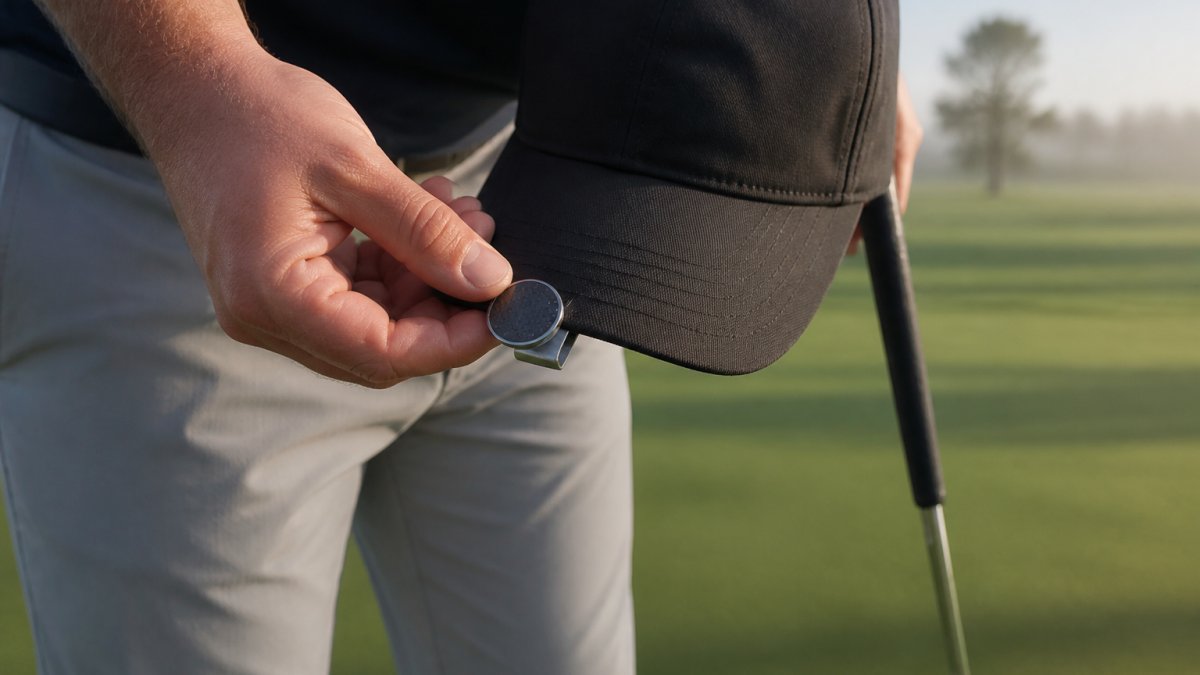
A magnetic marker needs a ferrous metal surface. In practice, that means one of four mounting points:
A common mistake is assuming all magnetic markers hold equally well. The magnet strength and the quality of the metal surface decide whether the disc stays put through eighteen holes of walking, cart rides, and bag jostling.
Attachment failure is almost always a fit problem, not a magnet problem. Check these before a round:
Players who wear a visor or no hat can mount the marker on a putter instead, which is where an all-in-one tool like Divot King earns its place. Its built-in magnetic ball mark sits on a universal sleeve adapter that fits most putters, so the marker travels with the club you use on every green. Whether you clip to a brim or mount to a shaft, fit and hold security come first.
A magnetic ball marker losing strength is usually an attachment problem, not a magnet problem: the disc slips when the metal surface is thin, the clip has bent, or debris has built up between magnet and base.
Start with a clean: wipe the magnet face and metal contact point with a dry cloth, since grit and grass clippings create a gap that weakens the hold.
A protective cover solves most of this. Divot King's click-on cover keeps the accessory contained in your bag, so the marker stays on its base between rounds instead of rattling around with everything else.
Marking your ball correctly is a courtesy as much as a rule. Place the marker directly behind the ball, never in front, so you do not alter the line of a putt.
Pace of play follows from good habits.
For players who want the marking and divot repair handled by one tool, Divot King combines a magnetic ball mark with spikes that aerate the soil and help fluff the green back into shape after a ball mark.
Magnetic markers are not right for everyone. Here is where they fall short, how to care for them, and how they compare with the alternatives.
A magnetic marker only reduces loss if the hold stays strong. A simple routine covers most of it:
A protective cover solves most of this. Divot King's click-on cover keeps the accessory contained in your bag, so the marker stays on its base between rounds instead of rattling around with everything else.
| Marker Type | Attachment | Access Speed | Loss Risk | Care Burden | Best For |
|---|---|---|---|---|---|
| Magnetic marker | Hat clip, putter base, or divot tool | Fast, one hand | Low when fit is right | Moderate, clean and store on base | Frequent players who want one-hand access |
| Coin marker | Loose in pocket | Slow, two hands | High | Low | Casual rounds, players with a trusted routine |
| Plastic marker | Loose or clipped | Moderate | Moderate | Low | Budget play |
| Nonmagnetic clip | Fixed clip | Moderate | Low | Low | Traditionalists who prefer a fixed attachment |
The comparison is not a clean win for magnetic. A coin has no magnet to weaken, no clip to bend, and no compatibility question, it depends on your memory. A magnetic marker trades that memory burden for a fit-and-care burden. Players who lose markers often, or want one-hand access, get the most from the trade; players with a reliable coin routine get little.
The gap between a smooth round and a frustrating one often comes down to small frictions, and hunting for a loose ball marker is one of them. If you want the marker, the divot repair, and the protection handled by a single tool that fits most putters, Divot King is built for exactly that: a built-in magnetic ball mark, a universal sleeve adapter, and a protective click-on cover for your bag. The R&A Rules of Golf on marking and lifting the ball and USGA guidance on pace of play both reinforce the same principle: keep the routine simple and keep moving.
The main benefits are speed and fewer lost markers. A magnetic golf ball marker stays attached to a hat clip, divot tool, or putter accessory, so you grab it and set it down without digging through pockets. Because it lives on your gear, it is harder to misplace between holes. Most players also find it keeps their pockets clear of coins and tees, which makes for a cleaner, smoother round.
It can, especially if the magnet is weak or the marker snags on a pocket lip or bag divider. Strong neodymium magnets and a recessed seat hold far better than flat disc magnets. Check the hold by shaking the clip gently before your round, and keep the marker seated when it is not in use. If yours drops often, the magnet has likely weakened or the clip has bent out of shape.
Yes. The Rules of Golf let you mark and lift a ball on the putting green, and they do not restrict what the marker is made of, so a magnetic marker is fine. The rules do cover where you place it: mark directly behind or beside the ball, and replace the ball on the same spot. A marker that sits flat and does not sit in another player's line keeps you compliant and keeps play moving.
Keep the magnet face clean and dry, since grit and grass clippings reduce contact. Store the marker seated on its clip or base rather than loose in a bag pocket where it can collect debris or stick to keys. Avoid leaving it in a hot car for long periods, and do not stack it against other magnets. If the hold fades after a season or two, replace the marker rather than trusting a weak magnet on the course.